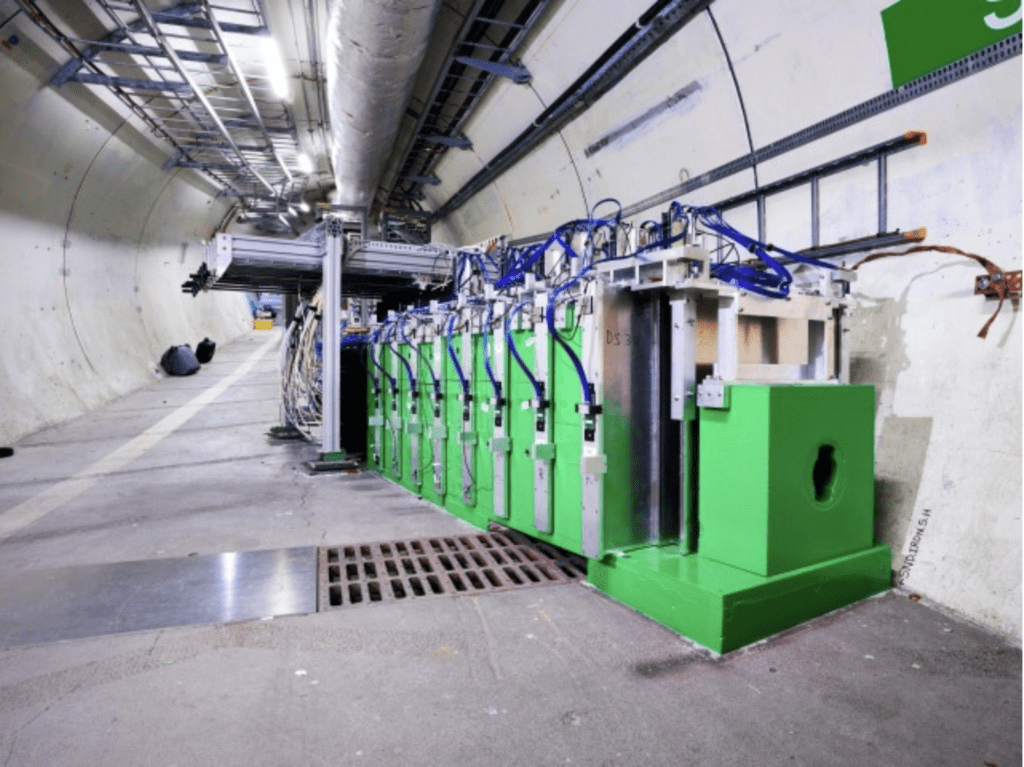
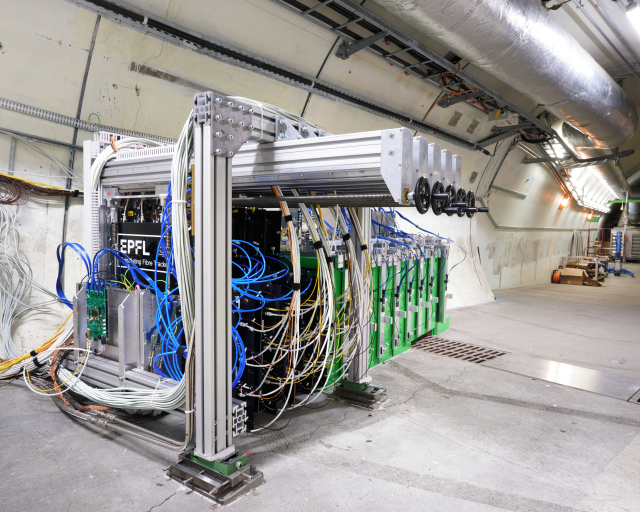
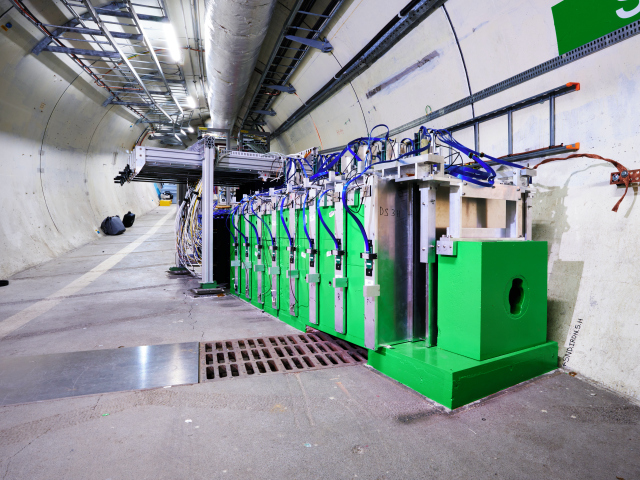
SND@LHC (Detector de Dispersión y Neutrinos en el LHC) es un experimento diseñado para estudiar los neutrinos, partículas fundamentales que no tienen carga eléctrica y cuya masa es extremadamente pequeña.
Aunque los colisionadores de partículas producen neutrinos en grandes cantidades, nunca se ha observado directamente un neutrino en un colisionador. Esto se debe a que interactúan muy débilmente con la materia, por lo que suelen pasar desapercibidos en los detectores convencionales. Además, la mayoría de los neutrinos generados en el LHC se encuentran en un rango de energía poco explorado, lo que hace que su estudio sea especialmente interesante.
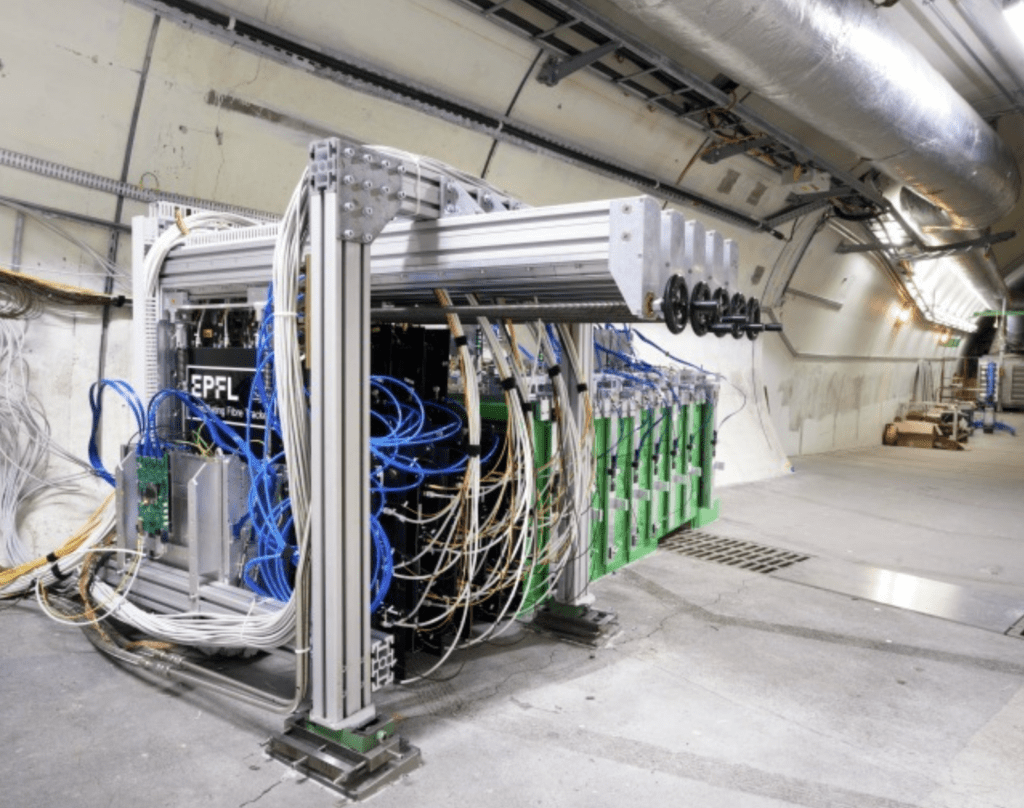
El detector SND@LHC está compuesto por un blanco de neutrinos, seguido de un dispositivo que mide su energía y detecta los muones —partículas similares a los electrones, pero más pesadas— producidos cuando los neutrinos interactúan con el blanco.
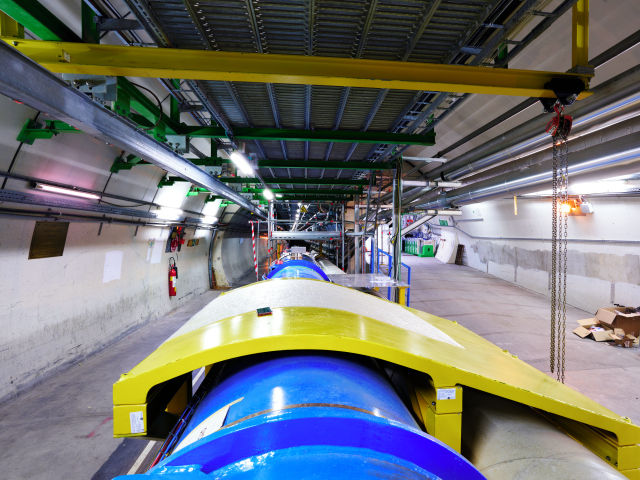
Este sistema está instalado bajo tierra, cerca del experimento ATLAS, en un túnel en desuso que conecta el LHC con el Sincrotrón de Protones Super (SPS). Situado ligeramente fuera de la línea del haz del LHC, el detector puede captar neutrinos producidos en colisiones del LHC que emergen con ángulos pequeños respecto al haz. Estos ángulos son más amplios que los cubiertos por FASERν, un subdetector del experimento FASER que también estudia interacciones de neutrinos a altas energías, pero ubicado directamente sobre la línea del haz.
Una gran parte de los neutrinos que detecta SND@LHC proviene de las desintegraciones de partículas formadas por quarks pesados, por lo que el experimento también permite estudiar la producción de este tipo de partículas en un rango angular inaccesible para otros experimentos del LHC.
Además, SND@LHC busca partículas débilmente interactivas no previstas por el Modelo Estándar, que podrían constituir la materia oscura.
El experimento fue aprobado en 2021, construido, instalado y puesto en funcionamiento bajo tierra en aproximadamente un año. Comenzó a tomar datos durante el Run 3 del LHC, que inició en julio de 2022.
El Instituto Milenio SAPHIR ha ido consolidando su participación en el experimento SND@LHC, una iniciativa pionera del CERN dedicada al estudio de neutrinos producidos en colisiones del Gran Colisionador de Hadrones (LHC), así como a la búsqueda de señales de nueva física. Dentro de esta colaboración, SAPHIR ha desempeñado un papel clave en diversas etapas del diseño, testeo y producción de componentes fundamentales del detector.
Entre sus contribuciones más destacadas se encuentra el trabajo con módulos TOF (Time-of-Flight), donde investigadores chilenos han liderado el diseño, pruebas de laboratorio y validaciones en haces de prueba (beam tests), todo orientado a mejorar la resolución temporal para la identificación precisa de partículas. Además, el equipo SAPHIR ha participado en la producción de un prototipo del calorímetro electromagnético tipo Shashlik, utilizando fotodetectores tipo SiPMs (Silicon Photomultipliers), y ha colaborado en sus pruebas con haces de partículas directamente en el CERN. Un aspecto innovador del trabajo del instituto es el desarrollo de análisis de datos mediante microscopía de escaneo en la Universidad Andrés Bello, una técnica crítica para la caracterización precisa de las interacciones registradas por el detector. Finalmente, SAPHIR colabora activamente en tareas de investigación y desarrollo conjunto con haces de piones, contribuyendo al entendimiento fino del rendimiento del detector frente a distintos tipos de partículas. Esta participación refuerza el compromiso del instituto con la física de alta energía y posiciona a Chile como un actor emergente en la investigación experimental de frontera.